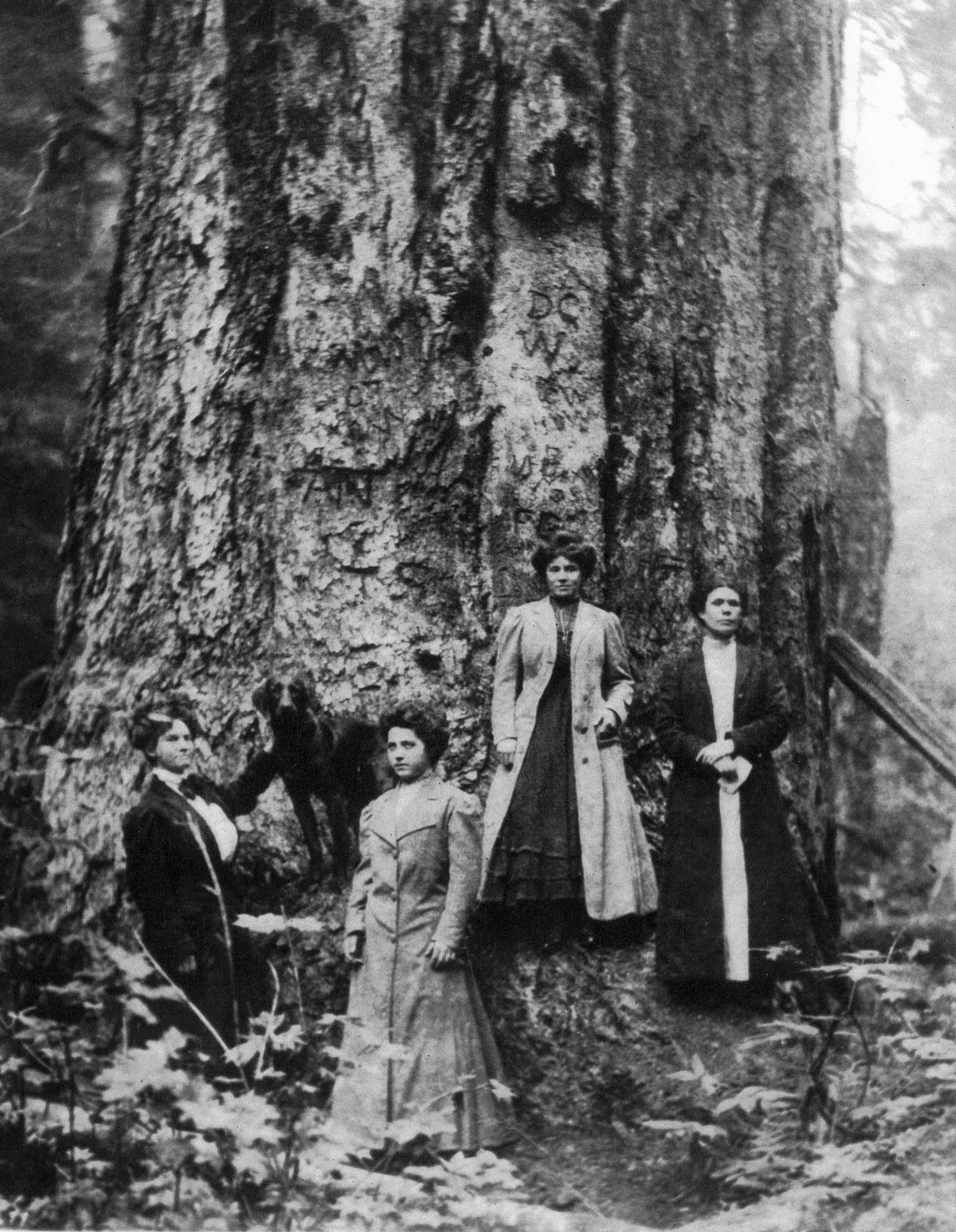
There was a tree up near Mineral that was huge — even to those that were used to seeing large, old growth trees. People came from all around to have their picture taken in front of it, like these four women here and their dog.
If you’d like to see another photo of people taken with the tree, just click HERE.
Photo courtesy of Rich and Ruthie Williams.
Click on image to enlarge.
 Eatonville To Rainier
14 responses to “Famous Tree Near Mineral – a True Giant”
It is my understanding that this tree was located along the Tacoma Eastern Railroad at a location known as Drawbar, which is just north of where the old town of Flynn was located along Mineral Creek. The TE trains used to stop at Drawbar so folks could go see this tree (see photo elsewhere on this web site). A portion of this tree is on display at the entrance to Pack Forest. Someday I hope to have some time to poke around at Drawbar to find the stump.
Brian Wise
General Manager
Mt. Rainier Scenic Railroad & Museum
LikeLike
I didn’t know that was the tree at Pack Forest. I’m off to take a picture of it today and add it to the site. Thank you! If you find the stump, please take a picture. 🙂
LikeLike
Hi Brian Wise,
Can you send me a map with the approximately location of the Mineral Tree near Mineral please. I found the railway near Mineral Creek but where are Drawbar and Flynn?
LikeLike
Di Mettler, did you ever get a picture of the Mineral Fir site (stump, if there is one)? Do you know of any huge Douglas firs in the Mineral area that were spared the saws? If so, we may be visiting your area around Aug. 22-23 and would appreciate any information about either the Mineral tree site or any other huge firs in your area. We’ll be staying at a cabin E. of Packwood from Aug. 21-28.
Thanks!
Darvel
Portland, OR
LikeLike
Hi, There are various pictures of this particular tree, but I haven’t been able to find any proof of it any more, aka the stump. There are huge trees around, but not necessarily in Mineral. This is the spot most folks go to see the big ones, Grove of the Patriarchs: http://www.wta.org/go-hiking/hikes/grove-of-the-patriarchs It’s a really easy walk and VERY close to Packwood. 🙂 Diane
LikeLike
The Mineral Big Tree was located on the edge of my grandfathers farm in Mineral. My dad showed me where it stood. Early on it was measured to be 417 feet by some government surveyers. I believe the ladies in the photo are my relation.
LikeLike
Great conversation! My name is Micah Ewers, and I am investigating the Mineral fir tree. I run a blog for 15 years, Pacific Forests/Rephaim23 Tallest Douglas Fir in America | Pacific Forests where I compiled over 320 accounts of historic Douglas fir trees >300 to 400+ ft tall (mostly felled length reports from lumbermen) My primary source is Dr Al Carder, who researched the Mineral fir for over 30 years, and he contacted townsfolk, Ms. Pearl Hill, and George S. Long, even a former US forest service chief, Richard McArdlle who had measured it. Carder concluded the giant was at least 393 ft tall, based on reports by the townsfolks (Hill and long) with original top section, 168 ft + and 225 ft standing snag, and 15.4 ft diameter. My question to Ronald E Sparkman, do you know where the tree stump location, latitude longitude might be, and if any of the 160-168 ft of top section, laying in the forest (measured by Joe Westover land engineer for the railroad in 1905, and Jess Hurd lumber operator, in 1930, and a class of Univ of Wash students in 1931 after it fell), might still exist,or any fragments of it that could be traced out? The Mineral tree is one of the best documented 400 foot giants, I believe the Nooksack giant of 465 feet was the tallest freshly cut and recorded fir in the NW in 1896, but other records of 400-430 ft felled firs existed in old surveys and lumber bulletins, such as in the foothills of Stillaguamish river, the Kase and Burchar pulpwood company, had a fir cruised near Granite falls in 1921, 17 ft diam, 420 ft estimated height, and other Nooksack river giants cruised at 400 ft tall in 1891 by John Saar and Sidney Soule, I think they did reach 400-430 ft range or even more. Working with Colin Spratt and other interested tree researchers of historical giants, we narrowed down that the Mineral tree must have grown near Drawbar summit, near the railroad tracks, where Roundtop creek meets Mineral creek, perhaps 1-2 miles N.E of the town of Mineral, and just south of Flynn. Richard Loden was the first pioneer who allegedly found the giant tree in the 1890s while hunting, and his land was near Flynn, so this sort of narrows the field, – I was curious where the Sparkman place stood, and if you have any more info, on this tree and what remains of it. The Nooksack Giant’s stump washed away in a 2003 flood of that river, according to Bill Devine who owns the old Alfred Loop homestead, and the Lynn Valley fir tree stump was cleared in 1910 with the building of Argyle road – so alas, I am curious if any trace of this magnificent Mineral tree exists! – Thanks! – Micah Ewers
LikeLike
Hi,
Wow, you have a lot of great reserach. Let me see what I can find out. Know people that live in Mineral that can probably tell me. 🙂
LikeLiked by 1 person
Hey! Thanks so much! Yeah, no pressure, I was just curious if any bits of the old stump exist, or portions of its fallen crown – if the townsfolk might have more specifics. It is possible too it was removed or ground up. Sometimes by chance, the rare exceptional old stumps survived the odds! The mammoth 17 ft diameter giant Douglas fir that was photographed near lake McMurray Skagit Co, was logged in 1906, but up till 2022 the eroded stump and portions of its abandoned trunk were still standing, almost 120 yrs later, on the Pilchuck Tree farm! Same with the 17 ft Satsop, or “Neby river” fir in the Olympics, the stump still exists deep in the woods. Most of my evidence currently places the Mineral fir, preliminarily at about 1 mile N.E. of Mineral town (or 1/2 to 3/4 mile as the crow flies), about where the Wiley “Jay” Sparkman land (once part of the old Richard Loden farm), bordered where the Round Top Creek meets the rail line – just before it merges with Mineral creek, at ~Drawbar. I also found new documentation that supports multiple academics in forestry had measured the giant: Dr Al Carder in 1981, had corresponded with William Eastman Jr a forester, who was a student of Prof. James Lindsay Alexander, UW college of Forestry, late 20s-late 30s. Alexander took the sophomore class, including Eastman to view and measure the giant tree at Mineral in April 1931, a year after it had toppled to the wind. Eastman took a photo of the class atop the fallen fir at the time, and he told Carder that while the exact measurements have been lost, the students did measure the fallen snag and the downed top – and the figure of 385 feet was apparently arrived at by the class, or by Leo Isaac and other officials. This 385 ft figure matches a later size reported by Jess Hurd, head of Pacific Lumber Co. in Mineral who in 1933 measured the fallen giant and its top, and was charged with yarding and loading the tree on to Eastern Tacoma rail cars to be processed as timber. A 100 ft log of the Mineral tree scaled 50,000 ft, and Jim Daly, who handled the log said it was the finest grain wood ever beheld by lumbermen. 4 yrs later, inn 1937, Dr Ellwood Scott Harrar, a UW Forestry colleague of Prof. James L Alexander (the forester who, along with his class measured the fallen tree in 1931), in his acknowledgements to his book, :”Textbook of Dendrology, 1st edition” he specifically thanks Prof. Alexander and Rcihard McArdle for their help with the manuscript – and on page 148, he mentions the great Mineral Douglas fir tree, and that it was “approximately 385 ft tall” and 15 ft in diameter. Because Dr Harrar was close to both Alexander, and McArdle, and in fact worked at Pack Forest (just north of Mineral) for a decade in the Forestry College, it is even plausible Dr Harrar may have seen or measured the great tree himself. I am looking for further archives within the university that might shed further light on Alexander and Harrar’s info, but now appears the giant both the standing snag (later wind fallen in 1930) and the broken off top, were measured by a decent number of trained persons. One old newspaper article estimates that as many as 10,000 passengers of the Eastern & Tacoma rail line may have stopped and visited the tree between 1905 and 1930! Dr Carder himself had collected and corresponded with over 9 witnesses who had viewed and or measured the tree, and over ten photos of it. I think there are now over 2 dozen well known pictures of the tree, and likely others yet to surface in archives. My hope is that perhaps a nursery log, near the rail line still lays deep in the brush, and theoretically could be measured, to confirm the records! It would have several hundred rings at that point, and a jagged 6 ft diameter base, in theory, where it tore off the great tree. Any case, thanks again! – Micah
LikeLike
I apologize that I haven’t gotten back. I haven’t been up that way yet to check with folks.
LikeLiked by 1 person
No problem! I chatted with a couple more people in the area, a Mr Chapman, who knows approx. where it once was, and several other loggers who recall other large and tall timber in the area. I’ll have to make a trek up there some time and investigate. Thanks again!
LikeLike
The Mineral Tree was 390 feet tall, taller than any known tree today. It fell in a storm in the early 20th century.It used to be common for fir trees to be taller than redwoods, but those no longer exist, primarily due to indiscriminate logging.
LikeLike
Thank you for this!
LikeLike
Great conversation! My name is Micah Ewers, and I am investigating the Mineral fir tree. I run a blog for 15 years, Pacific Forests/Rephaim23 Tallest Douglas Fir in America | Pacific Forests where I compiled over 320 accounts of historic Douglas fir trees >300 to 400+ ft tall (mostly felled length reports from lumbermen) My primary source is Dr Al Carder, who researched the Mineral fir for over 30 years, and he contacted townsfolk, Ms. Pearl Hill, and George S. Long, even a former US forest service chief, Richard McArdlle who had measured it. Carder concluded the giant was at least 393 ft tall, based on reports by the townsfolks (Hill and long) with original top section, 168 ft + and 225 ft standing snag, and 15.4 ft diameter. My question to Ronald E Sparkman, do you know where the tree stump location, latitude longitude might be, and if any of the 160-168 ft of top section, laying in the forest (measured by Joe Westover land engineer for the railroad in 1905, and Jess Hurd lumber operator, in 1930, and a class of Univ of Wash students in 1931 after it fell), might still exist,or any fragments of it that could be traced out? The Mineral tree is one of the best documented 400 foot giants, I believe the Nooksack giant of 465 feet was the tallest freshly cut and recorded fir in the NW in 1896, but other records of 400-430 ft felled firs existed in old surveys and lumber bulletins, such as in the foothills of Stillaguamish river, the Kase and Burchar pulpwood company, had a fir cruised near Granite falls in 1921, 17 ft diam, 420 ft estimated height, and other Nooksack river giants cruised at 400 ft tall in 1891 by John Saar and Sidney Soule, I think they did reach 400-430 ft range or even more. Working with Colin Spratt and other interested tree researchers of historical giants, we narrowed down that the Mineral tree must have grown near Drawbar summit, near the railroad tracks, where Roundtop creek meets Mineral creek, perhaps 1-2 miles N.E of the town of Mineral, and just south of Flynn. Richard Loden was the first pioneer who allegedly found the giant tree in the 1890s while hunting, and his land was near Flynn, so this sort of narrows the field, – I was curious where the Sparkman place stood, and if you have any more info, on this tree and what remains of it. The Nooksack Giant’s stump washed away in a 2003 flood of that river, according to Bill Devine who owns the old Alfred Loop homestead, and the Lynn Valley fir tree stump was cleared in 1910 with the building of Argyle road – so alas, I am curious if any trace of this magnificent Mineral tree exists! – Thanks! – Micah Ewers
LikeLike